For clinicians
Signal, not noise. Halo is engineered against alarm fatigue.
Halo Connected Health gives clinicians involved in a patient’s care — GPs, community nurses, consultants, allied health professionals — a longitudinal view of the wellbeing signals that matter, and only alerts you when something meaningful has changed. Per-patient adaptive baselines, care-plan-aware routing, clinical safety documented from day one.
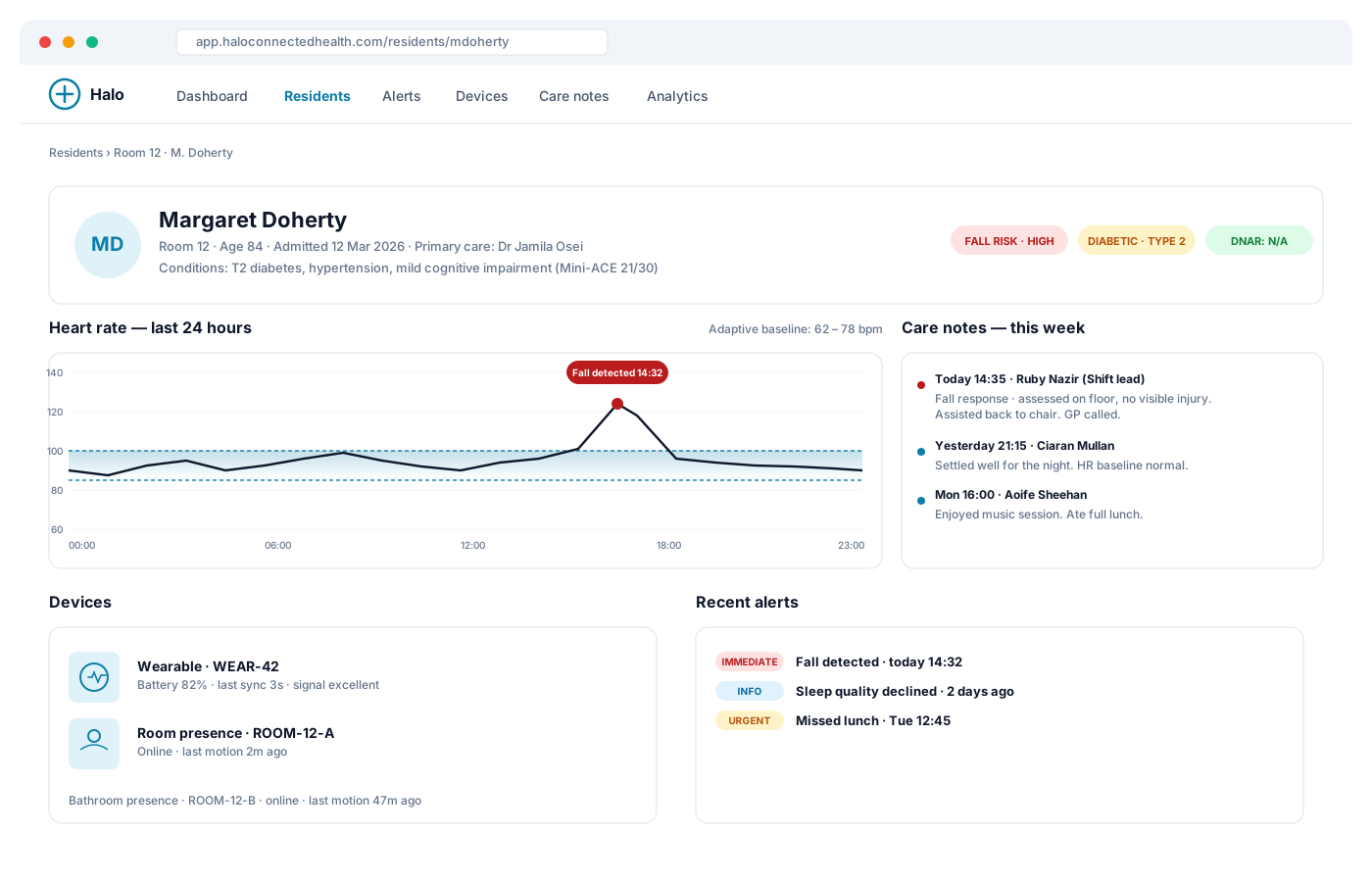
What Halo puts in front of you
You do not need a new EHR. Halo integrates with the systems you already use. When you’re viewing a patient in Halo, you get:
- Longitudinal trend — sleep quality, activity, vitals if a wearable is worn, environmental exposures. Trend windows configurable (24h, 7d, 30d, custom).
- Alert history — every alert triggered, acknowledged by whom, and how it was resolved. Full audit trail.
- Adaptive baseline — the patient’s own normal, learned over the first 2–3 weeks, not a population norm.
- Care-plan context — the current care plan, quiet-hours preferences, escalation contacts, and any restrictions (e.g. DNACPR, mental capacity documentation).
- Consent state — what the patient has consented to share, and with whom. Overrides on emergency access are logged and reviewable.
Alerting philosophy
Alarm fatigue is the single largest reason connected-care technology fails in clinical settings. Halo is engineered against it:
- Per-patient thresholds — a heart rate of 45 is normal for a marathoner and alarming for an 85-year-old with heart failure. Halo learns each patient’s normal.
- Adaptive baselines — thresholds move with the patient over weeks and months, not a fixed value at admission.
- Severity tiers — not every alert is an emergency. Halo distinguishes: immediate (fall detected), urgent (missed morning routine), and informational (trending sleep quality decline).
- Time-aware routing — the same event routes differently based on time-of-day, on-call rota, and quiet-hours configuration.
- Escalation on inaction — if an immediate alert isn’t acknowledged within the configured window, it escalates automatically up the on-call chain.
Alerts you dismiss inform the model. Over time the platform learns what matters to your service and what doesn’t.
Clinical safety
Clinical safety is designed in, not bolted on:
- DCB 0129 — the manufacturer’s clinical safety documentation, produced with a nominated Clinical Safety Officer, available under NDA
- DCB 0160 — the deployment-side clinical safety documentation, provided as a template for your organisation to adapt
- Hazard log — maintained continuously; new hazards identified through incident review are added and mitigated in subsequent releases
- Post-market surveillance — every incident that touches Halo can be triaged against the hazard log, with root cause analysis outputs feeding back into the product
- Change control — safety-relevant changes go through a documented review before release, with rollback paths tested
We do not claim to replace clinical judgement. Halo surfaces signals; decisions are yours.
Integration into your day
Halo is designed to fit around clinical workflow, not the other way around:
- Web dashboard on any browser, no plug-ins
- Clinical mobile for on-the-move review, works offline with sync-on-reconnect
- HL7 v2 and FHIR R4 to your EHR — configurable per contract
- NHS Number support where consented
- SSO via SAML or OIDC — no separate password to remember
- Care team invitations — GPs, community teams, and specialists can be invited into a patient’s care view (with consent) for the duration required
Support is provided by a UK-based team with clinical background. Escalations for Enterprise-tier customers route to a named account engineer.
Related
- Alerts & Escalation — how alert routing and escalation work in detail
- Predictive healthcare — the AI roadmap for fall prediction, frailty, infection detection, cognitive decline
- NHS & ICS — procurement, integration and framework position