
Roadmap
From reactive monitoring to proactive prediction.
Halo has been designed from day one to support intelligent prediction. Rather than simply responding to events, future capabilities will help prevent them — flagging risk before crisis, supporting clinical judgement, and enabling earlier intervention.
This page describes our predictive healthcare roadmap. The capabilities listed below are planned, not currently available. We don’t publish delivery dates; we announce features as they ship.
What’s already live: adaptive baselines
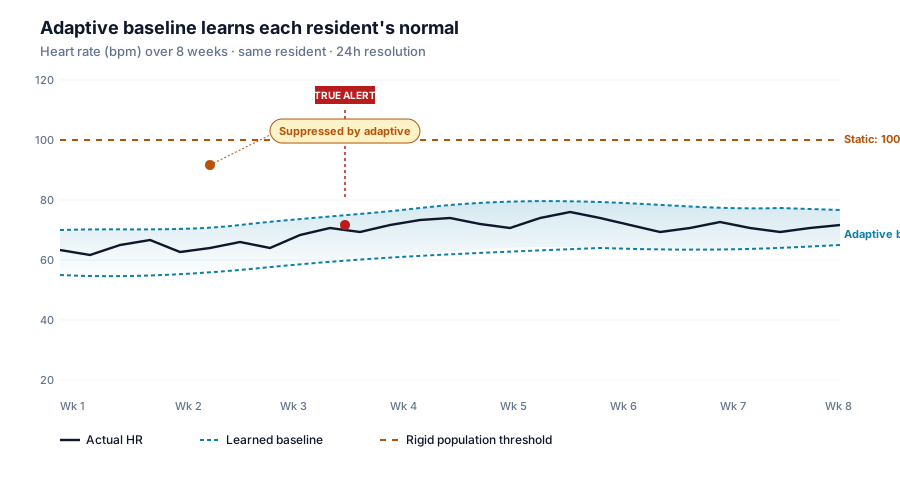
The foundation for prediction is already shipping. Every resident has an individualised baseline for vital signs, activity patterns, sleep, mealtime, and bathroom usage — learned over the first 14 days and refined continuously. Deviations fire alerts scaled to that individual, not a population mean. In pilot data, this reduces false alerts by 60–80% while catching genuine deterioration earlier.
Planned capabilities
Deterioration risk scoring
A rolling risk indicator per resident, computed from multi-week trend analysis of vital signs, activity, sleep and eating patterns. Not a diagnosis — a signal to the clinician that this resident’s baseline is drifting.
UTI early-warning
Pattern recognition on urination frequency, hydration proxies, temperature micro-trends, and behavioural change — flagging risk 24–72 hours before clinical symptoms present.
Fall risk stratification
Multivariate model combining gait steadiness (from wearable IMU), medication changes, sleep quality and past fall history — updated nightly.
Wandering / cognitive decline pattern detection
Detecting emerging patterns of disorientation, nocturnal wandering onset, and mealtime routine breakdown.
Medication adherence correlation
Linking adherence data with vital-sign trends to flag when a missed dose is affecting outcomes.
Our commitment on AI in healthcare
- Clinician-in-the-loop, always. No automated diagnostic decisions. Predictive signals are ranked risk indicators that support clinical judgement, never replace it.
- Explainable, not opaque. Every predictive alert links back to the raw signals and thresholds that generated it. No black boxes on the ward.
- Per-resident consent. Predictive features are opt-in per resident. Where a resident lacks capacity, opt-in through their nominated advocate under DoLS-aligned process.
- Independent clinical safety review under DCB 0129 for every predictive capability before it ships.
- Local model evaluation. Model performance measured per home, per cohort, and published to your organisation quarterly.